|
Don't Be Dumb, Get a Smart Thermostat
Abstract
Worldwide, wasted energy use is a significant problem, but on a University
campus it is most prominent. Students tend to leave their lights on when
they leave rooms and keep their electronics plugged in at all times, thus
wasting energy. But, in the new dorms Arbol de la Vida and Likins they have
found a solution to fix this problem of wasted energy. The dorms have a
device called a smart thermostat. Its main function is turning off all power
in the room when it senses the rooms is unoccupied; it turns off the lights
and air cooling/heating system. As a team our goal is to implement these
devices throughout the entire campus to save energy and become a step closer
to being a "green" and sustainable school.
Tiana Soto, Elizabeth Towne, Alexandra
Richardson, Kevin Spangenberg
Please click here for a video introduction to this
project (82mb)
Please click here for more information on this
project
|
 |

Biodiesel for Humanity
Abstract
Habitat for Humanity uses 5-10 gallons of diesel a month, and this project
would completely cover their fuel needs,
Using the existing on-campus biodiesel project, we will be creating
the biodiesel on campus and donate the biodiesel to local nonprofits to
eliminate their fuel costs. This will allow them to allocate more funds to
community projects and reduce their carbon footprint.
We can expand upon the project by also accepting waste from local
restaurants and businesses to create more volume of biodiesel and contribute
more to the community. As the
project grows, we can also expand the beneficiaries by donating biodiesel to
the entire Habitat for Humanities in Arizona, which needs about 130 gallons
per month, still leaving 370 gallons for the U of A.
Five dollars will be added to each student "green fees" to help offset
the overall cost of the program which will cover not only start up fees but
help with transportation costs to distribute biodiesel to Habitat for
Humanities across the state of Arizona.
Jenna Botticelli, Heather Howe, Grace Schau, Ujjesha Singh, Mary Williams
Please click here for a video introduction to this
project (31mb)
Please click here for more information on this
project
|
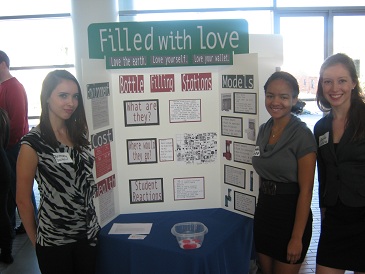 |
Filled with Love
Abstract
We propose implementing refillable water bottle stations throughout the
University of Arizona campus. These refillable water bottle stations, by
Elkay, efficiently refill a reusable water bottle due to their design. The
stations produce water more quickly than water fountains and are more
sanitary due to their touch-free sensors. Establishing these stations on
campus would help the University of Arizona reduce the amount of plastic
water bottle waste it produces by encouraging the use of a reusable water
bottle. It is important to stay hydrated in Arizona’s weather and having
these stations around campus would help maintain the health of its students.
The stations can be put indoors or outdoors, making them easily accessible.
Elkay offers several different models, some specifically designed for only
refilling a reusable water bottle and some that also include a traditional
water drinking fountain. Overall, implementing these stations would promote
environmental friendliness and health awareness.
Annie Mielke, Sydney Beke, Brittney Smith
Please click here for a video introduction to this
project (7mb)
Click here for additional information on the
project.
|
 |
Cafeteria Cats
Abstract
Our goal is to promote sustainable eating habits in the Student Unions here
at the University of Arizona. After switching to 100% compostable to-go
containers throughout the Student Unions, we would like to ensure that there
are several composting stations in the restaurants as well. Also, we would
like to provide dinnerware for students to use instead of disable containers.
These products would then be washed and reused similar to a more tradition
cafeteria. In order to encourage students to be more sustainable, a
twenty-five cent increase in all items would be rebounded by customers
receiving a twenty cent discount when choosing the dine-in option instead of
using to-go boxes. We encourage you to stop by to learn all the details of
how our idea can make a huge difference at the U of A.
Abigail Cohen, Brooke Atkins,
Nicole Reese, Sarah Laus
Please click here for a video introduction to this
project (14mb)
Please click here for more information on this
project
|
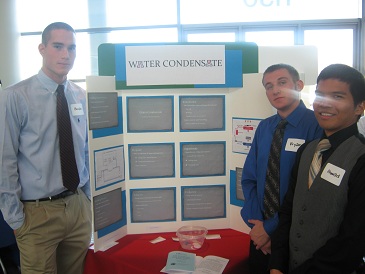 |
Water Condensate
Abstract
In the University of Arizona, water is used extensively to regulate ambient
temperatures of buildings and research facilities using huge water coolers
and a chilling water system. Since AC units are extensively used during
summer, which can be as long as half a year, the amount of condensate
collated is overwhelming. One
thing worth nothing is that the condensate is very clean, as the
condensation process is similar to a distillation cleansing procedure. Thus,
two key factors are that the condensate is of high purity and low in
temperature. The cooling
towers in the University of Arizona use water for cooling purposes. As such,
by funneling the water condensate to the water-cooling towers, this not only
provides more free water for cooling purposes, saving the cost of water
itself, but also reduces chemical and sewer costs associated with sending
less treatment chemicals to sewer per ton of cooling.
Brian Stevens, Ahmad Hakeem, Brian Waxmen
Please click here for a video introduction to this
project (75mb)
Please click here for more information on this
project
|
 |
Energy Pop
Abstract
We propose to implement a policy of campus wide Energy Star vending
machines. Vending machines with the Energy Star rating have been shown to
increase energy efficiency by up to 50%, and could potentially lead to a
reduction of hundreds of kWh consumed on campus.
We understand that having vending machines, especially ones that
provide drinks, are necessary for the climate we live in, we also know that
the University uses them as a way to make a profit, but they are wasting
money with all the energy that regular vending machines consume. With the
stand-by time when no one is using them and they just remain on because they
have to constantly keep the drinks cold. Energy Star machines can achieve
this as well as cutting down on the total energy used by the vending
machines, saving money and the environment. This initiative has been
implemented in other university campuses and has led to over $20,000 in
annual savings and a reduction of over 200,000 kWh.
Brittany Boegemann, Shelby Bowers,
Blanca D. Romo, Taylor Billington
Please click here for a video introduction to this
project (7mb)
Please click here for more information on this
project
|
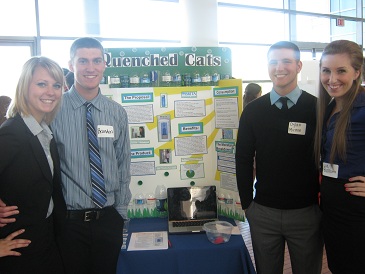 |
Quenched Cats
Abstract
We propose to address the growing concern for disposable water bottle
consumption on campus by installing various Hydration Stations around the
main student-congregating areas. These will be filtered water stations that
will prompt students to use their refillable water bottles more often than
purchasing new disposable ones. The Hydration Station is a product designed
and manufactured by Brita, a trusted water filtration company. These stations
have been implemented in a few other universities nationwide and the
response/result is always the same: happier students/greener campus. Since
the main reasons for students to purchase disposable water bottles are simply
the convenience factor and the fear of trusting the tap-water fountains to
quench their thirst, providing a free, filtered, easily-accessible option to
refill their water bottles will help alleviate the plastic crisis. In the
long run, this investment will also diminish much of the cost of trash and
water bottle collection campus wide.
Elizabeth Bollum, Brandon Hecke, Dylan Mustoe, Sarah Parkos
Please click here for a video introduction to this
project (23mb)
Please click here for more information on this
project
|
 |
Lamination Innovation
Abstract
The University of Arizona campus restaurants throw away an alarming amount of
paper ordering slips daily. If each restaurant created a reusable set of
slips that were cycled through consecutive customers, our campus could
essentially save a massive amount of paper and money that is otherwise being
wasted. These slips could be laminated and written on with a crayon/marker to
ensure a long life cycle. Reusable slips would not only be an effort to
reduce the amount of waste the university produces, but also a method of
cutting down on costs. While laminated slips hold an original premium cost
over basic slips, they save money in the long term. Paper, ink, and labor
costs could also be potentially saved, generating a sustainable progression
for our University’s restaurants.
Tyler Miller, Trevor Morgan, Cody Franz, Cameron Chery
Please click here for a video introduction to this
project (47mb)
Please click here for more information on this
project
|
 |
Going Green with Grey
Abstract
The amount of water that is used at the University of Arizona daily is
unbelievable, so for our project we focused on Yuma Hall as a candidate for a
grey water system. On average Yuma uses upwards of 200,000 gallons of water
each month, making both the monthly water bill and the impact on the
environment substantial. Our plan is to retain and filter the grey water from
sinks, showers, and washing machines, which then could be used to water the
surrounding vegetation. The grey water filtration system, made by ReWater
Systems, will include a 2,000-gallon tank and an irrigation system that will
water the neighboring trees and grass.
Ryan Graham, Benjamin Malisewski, Cooper Kowalski, Danny Cardella
Please click here for a video introduction to this
project (19mb)
Please click here for more information on this
project
|
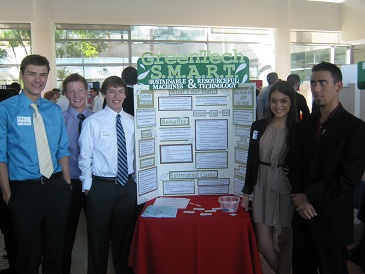 |
Green S.M.A.R.T
(Sustainable Machines and Resourceful Technology)
Abstract
Our proposal is to reduce the paper that the University of Arizona uses by
creating a paperless food ordering system. This system consists of the
development of a food ordering app as well as touch-screen kiosks placed in
the restaurants that currently have paper-based processes. Orders can be
placed either through the app or the kiosk in the restaurant. The app can be
linked to a CatCard to facilitate online payment and to insure that the
consumer will come to pick up his/her food. This system is advantageous
because it saves paper and enhances the consumer experience. In addition,
from a managerial standpoint, it is a much more efficient system in terms of
tracking inventory because the computer tracks exactly how much of each item
is sold. The GreenTech S.M.A.R.T. system brings food ordering from a
wasteful, disorganized process to a streamlined and efficient one.
Noah
Sleiman, Alex Kulpinski,
Rae Cooper, Cody Pullen, Kevin Johnson
Please click here for a video introduction to this
project (195mb)
Please click here for more information on this
project
|
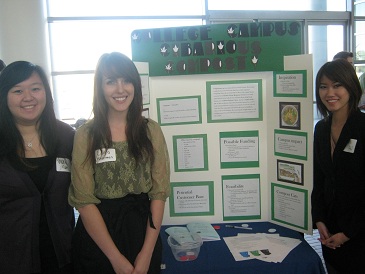 |
College Campus Cibarious Compost
Abstract
Composting is a growing concept around the country. Many people compost in
their own homes but what if our campus supported composting? How effective
would that be? Student Union Memorial Center is the place where most of the
food is consumed on campus. Our main targets are Cactus Grill, Main Cafeteria
(Burger King, Panda Express, etc.), and the Park Student Union. Just like a
regular trash can, we plan on placing a compost bin around the dining areas.
It would also be efficient if there were bins in the back kitchen so that the
workers can compost the excess food at the end of the day. By composting the
surplus food, we could minimize wasted food and trash waste.
Laura Kitterman, Mun Aw,
WenChi (Vicki) Fan
Please click here for a video introduction to this
project (83mb)
Please click here for more information on this
project
|
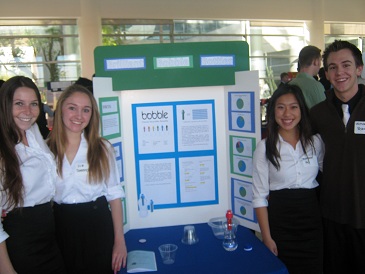 |
Brilliant Bobble Bottles
Abstract
Our project focuses on reducing the use of plastic campus-wide through
implementation of the “Bobble”.
The Bobble is a reusable, refillable water bottle that filters water as one
drinks from it. This bottle uses
a carbon based filter that will filtrate up to the equivalent of 300 plastic
water bottles. Besides cutting down plastic intake, the Bobble would generate
better quality water than both water fountains on campus and the average
water bottle. Our proposal, therefore, is for the University of Arizona to
provide students with these Bobble water bottles at the beginning of each
academic year in hopes of reducing the number of plastic water bottles sold
on campus.
Elizabeth Simmons, Stephanie Ho, Mike Reaves, Michelle Redding
Please click here for a video introduction to this
project (45mb)
Please click here for more information on this
project
|
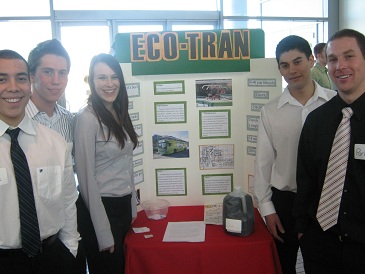 |
Eco-Tran
Abstract
We believe the University of Arizona should adopt the Opbrid/e-traction
system to create electric buses to promote a more environmentally-friendly
campus. The system has already shown great success in retrofitting gasoline
or diesel buses in Europe, especially Sweden. The buses are retrofitted with
this system by removing the diesel drivetrains and refitting their wheel
motors. The buses run off the energy from small batteries, but do have a
back-up generator and the ability to automatically switch to diesel in
emergencies, which makes the system more reliable. The electric Cat-trans can
recharge at the end of each bus route, due to Opbrid's innovative and rapid
charging technique. Funding for this project can come from companies who want
to put their logos on the buses and from a portion of the University of
Arizona’s budget towards sustainability. The new electric system on the
already existing Cat-tran buses will save the University money in the long
run and create a cleaner and greener campus.
Jorge Gaona, Kyle Heitmann,
Macy Walker, Parker Woodruff
Please click here for a video introduction to this
project (12mb)
Please click here for more information on this
project
|
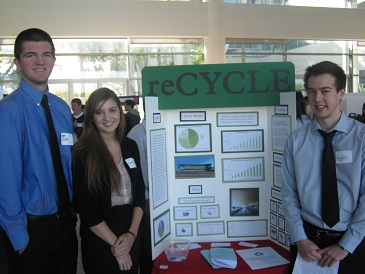 |
reCYCLE
Abstract
Energy use at the University of Arizona is astronomical. With constant
efforts to reduce, reuse and recycle, universities and other corporations are
investing in green technologies. We propose to introduce a revolutionary
system that captures kinetic energy produced by individuals using aerobic
machines at the fitness and recreation center at the University of Arizona.
This system has the ability to produce, and store approximately 50 watt-hours
of electricity for every 30-minute workout that an individual completes. This
system not only reduces the energy costs at the University of Arizona, but
allows the campus to appeal to students and faculty whom are interested in
environmentally friendly projects.
Tim Brousse, Austin Paeper, Lauren Preble
Please click here for a video introduction to this
project (93mb)
Please click here for more information on this
project
|
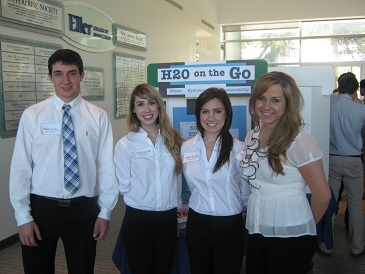 |
H2O on the Go
Abstract
We propose to install Elkay EZH20, a water bottle filling station that will
promote a sustainable way to stay hydrated and protect our planet. Elkay
offers a variety of models that can easily be implemented around campus on
top of preexisting drinking fountains in dorms, the Rec Center, student
unions, and the library. By installing the EZH2O, the amount of plastic
bottles disposed will decrease dramatically. People will be encouraged to
reuse plastic water bottles and purchase reusable water bottles. The
increased sustainability will be easy to observe with the display board of
the device showing the number of plastic bottles kept out of landfills.
Installing these devices throughout campus can have an impact that reaches
further than the U of A. By making efforts to increase sustainability as a
campus, other institutions in the state of Arizona will follow in our steps,
promoting a more sustainable state.
Margo Mesch, Barb Michalik,
Lauren Cohrs, Brian Herrera
Please click here for a video introduction to this
project (6mb)
Please click here for more information on this
project
|
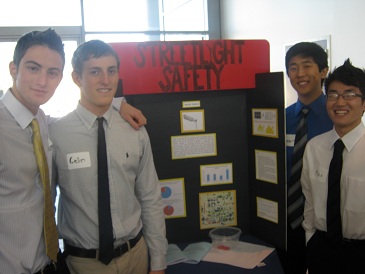 |
Streetlight Safety
Abstract
Our proposal is to install motion sensor pathway lights to illuminate areas
throughout campus where lighting is too dim. Numerous students feel unsafe
walking through these areas at night, and believe that the addition of more
luminous and efficient lights will help them feel more secure. The solar
powered lights we are installing not only provide cost effective source of
lighting, but a renewed sense of safety for all University of Arizona.
Colin Butler, Mike Choi,
Brian Bellinson, Robin Chang
Please click here for a video introduction to this
project (33mb)
Please click here for more information on this
project
|
|
|